Just like everything else in Japan, there are many unwritten rules for riding the trains. The public transportation system in Japan is one of the best in the world, if not the best. If you join one of our tours, or if you travel on your own, you will probably have the opportunity to ride many trains. While it’s not necessary to know and/or follow all of the rules, a little knowledge will go a long way towards creating a positive reputation with the locals. They will appreciate any efforts regardless. Anyway, here is a list of dos and don’ts.
IN THE STATION
- Do not block walkways and force people to walk around you and your group
- When entering or exiting a station, you should stop short of the turnstiles and prepare your tickets before approaching the turnstiles so as not to impede access to the turnstiles. When you arrive at the turnstiles, you should be prepared to quickly insert your tickets and move on.
- Finding your bearings in a train station can be difficult sometimes. When using escalators or elevators, you should move away from the escalators and elevators while determining how to proceed.
- Many of the stairs at train stations have sections of the stairways marked for those who are going up and down. You should follow these directions when ever possible. This is especially true for stairways supporting commuter lines during rush hour (7AM to 8:30AM and 5:30PM to 6:30PM)
- Do not be an 歩きスマホ (walking phone) or スマホゾンビ (phone zombie). These are people who are absorbed by their phones while walking. Unfortunately, you will see a lot of Japanese doing this.
BOARDING
- Avoid using commuter trains or subways if you have large suitcases, especially during rush hours (7AM to 8:30AM and 5:30PM to 6:30 PM)
- Most of the train doors on trains in Japan, open and close automatically. But in some rural areas, the train doors are opened and closed by a button next to the door on the inside and outside of the train,
- Some busy commuter lines will have “Women Only” cars. Sometimes these are only used during rush hour, but in some cases the cars are used all day long. The location of the “Women Only” cars will be marked on the platform and on the train cars themselves. The observed hours will also be included on the signs.
- The actual boarding process is different depending on the type of train. The Shinkansen (bullet trains) and most limited express trains have only one line, however, local trains and subways often will have two lines. If there is only one line, stand to the side of the door to allow people to exit the train first. After everyone has exited, it is OK to board the train. If there are two lines, stand to the side of the door after the train arrives and allow everyone to disembark. Once everyone has exited the train, it is OK to board.
ON THE TRAIN
- Keep noise levels to a minimum. (This is probably the most important rule.)
- Do not make or receive a phone call on the train. If you have to use the phone, you should go to an area between cars (not available on local trains)
- Eating or drinking is allowed only on Shinkansen and Limited Express trains
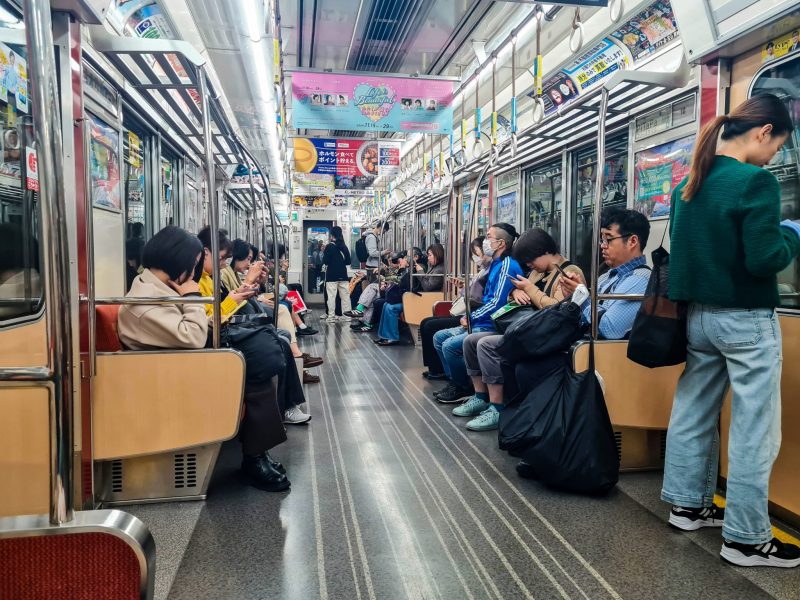
- Many local trains will have “Priority” seats. These seats are designated for the elderly, disabled, pregnant, or injured passengers, marked by specific seat colors and window stickers. While anyone can use them it is courteous to keep them open for those in need and mandatory to offer the seat immediately if someone needing it arrives.
- You should only use enough room for one person. If you have bags, you should keep then on your lap, or on the floor at your feet. Do not put then on the seat next to you.
- If you have a backpack, you should wear it on the front instead of on your back.
- No sitting on the floor
- Keep aisles clear
- When reclining seats, consider the passenger behind you.
- If you recline your seats, please reset the seat to the fully upright position when exiting the train
- Do not leave trash when you exit the train. On the Shinkansen and limited express trains there may be trash receptacles near the train doors, or there will be trash receptacles on the platform.
HAPPY TRAIN RIDING!!